
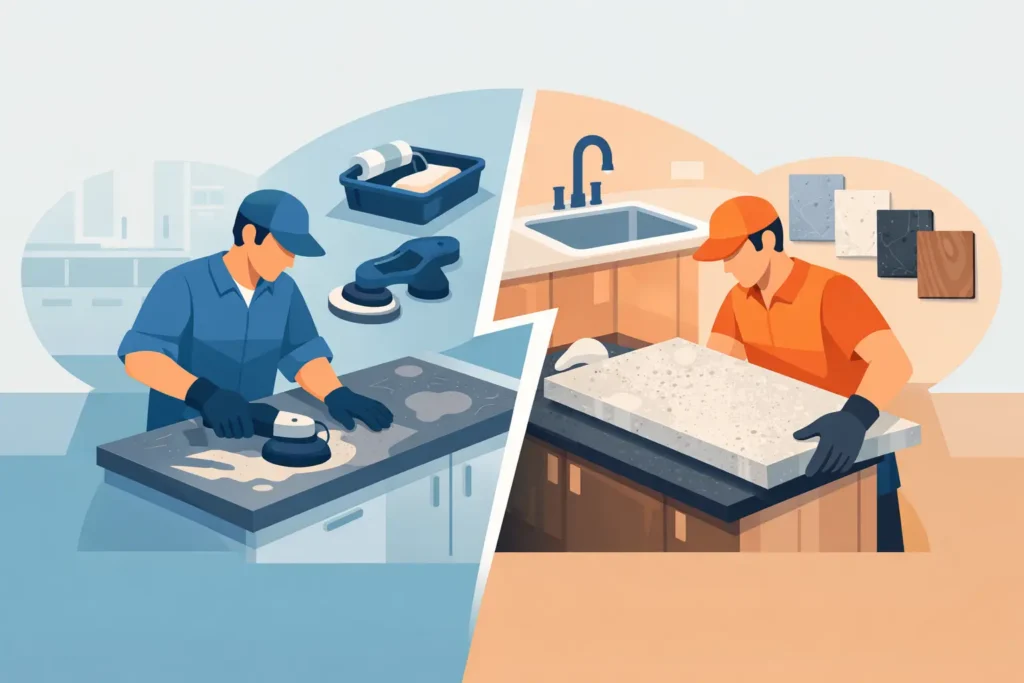
A dated countertop can make an otherwise well-designed kitchen or bathroom feel tired. Yet resurfacing vs replacement countertops is not simply a question of choosing the lowest price. The right route depends on the condition of the existing surface, how you use the room, the finish you want to achieve, and how much disruption your property can accommodate.
For many homeowners and property decision-makers, resurfacing offers a high-end visual transformation without the demolition, plumbing complications, and extended downtime associated with a full tear-out. Replacement still has its place, especially when the structure beneath the surface has failed. Understanding the difference helps you invest with confidence rather than paying for more work than your project actually needs.
Resurfacing vs Replacement Countertops: The Core Difference
Countertop resurfacing keeps the existing countertop in place and transforms its visible finish. A specialist prepares the surface, repairs appropriate minor imperfections, and applies a new coating system designed for the environment. With a premium spray granite finish, the result can bring the depth, texture, and visual character associated with natural stone to an existing counter, while creating a practical, easy-care surface.
Replacement means removing the existing countertop and installing a new one. This may involve disconnecting sinks, faucets, cooktops, and appliances; modifying cabinetry; adjusting backsplash areas; and coordinating several trades. It gives you a completely new substrate and can change the countertop layout, but it also creates more waste, more disruption, and usually a higher overall project cost.
Neither option is automatically better. Resurfacing is a smart renovation choice when the countertop is fundamentally stable but visually outdated, stained, worn, or no longer aligned with the room’s design. Replacement is the responsible choice when there is severe water damage, structural movement, major swelling, deep cracking, or cabinetry that can no longer support the surface safely.
When Countertop Resurfacing Makes the Most Sense
Resurfacing is particularly valuable when the bones of the kitchen or bathroom are sound. A laminate, solid-surface, tile, or previously coated counter may look beyond saving at first glance, but appearance and structural condition are different issues. If the substrate is stable, properly fixed, and free from serious moisture damage, a new surface finish can deliver a striking upgrade without rebuilding the room around it.
The strongest advantage is efficiency. Keeping the existing counter in place avoids a large part of the demolition process. That can mean less mess in occupied homes, less interruption for commercial settings, and fewer connected elements to remove and reinstall. In a kitchen, preserving the existing layout can also reduce the risk of unexpected changes around appliances, wall finishes, and plumbing.
A spray granite system is especially compelling for clients who want a luxury stone-inspired appearance but do not want the weight, expense, or installation process of traditional slab granite. The finish can be tailored through color and texture selection, allowing a countertop to complement cabinetry, backsplashes, wall finishes, and bathroom features rather than forcing the rest of the room to work around a preselected slab.
Resurfacing is also well suited to projects where hygiene and maintenance matter. A professionally applied, properly sealed finish can create a waterproof, durable, and easy-to-clean surface. For bathrooms, wet areas, rental properties, hospitality spaces, and busy family kitchens, these practical performance qualities are as valuable as the visual transformation.
What resurfacing can and cannot repair
Professional preparation can address many cosmetic concerns, including worn color, minor chips, light surface scratches, outdated patterns, and grout-heavy tile countertops. It can also create a more cohesive look where several surfaces need to work together.
However, resurfacing should not be used to disguise a failing substrate. Counters that are soft from water exposure, lifting away from cabinets, badly warped, extensively cracked, or damaged around sink cutouts need further investigation. A trusted installer will assess the condition first and recommend replacement when it is the safer long-term investment. A beautiful finish is only as dependable as the surface beneath it.
When Full Countertop Replacement Is Worth It
Replacement becomes the better decision when your renovation requires a structural change. If you are changing the kitchen footprint, moving a sink, adding a larger cooktop, extending an island, or replacing damaged cabinets, a new countertop may be necessary to suit the new layout.
It is also appropriate when the existing material has reached the end of its serviceable life. Particleboard counters that have swollen from persistent leaks, old tile installations with movement beneath them, or counters with widespread delamination are not strong candidates for a surface-only renovation. In these cases, keeping the existing substrate can create a false economy.
There are design reasons to choose replacement, too. Natural stone slabs, thick quartz profiles, integrated sinks, and dramatic waterfall edges require new fabrication and installation. If one of these features is central to your vision, resurfacing will not replicate every construction detail.
The trade-off is that replacement often brings hidden costs beyond the material itself. Removal and disposal, appliance disconnection, plumbing work, wall repairs, new backsplashes, and cabinet alterations can all expand the scope. A countertop quote may look straightforward at the start, but the surrounding work can quickly become the more significant part of the budget.
Comparing Cost, Downtime, and Long-Term Value
The most useful comparison is not just the initial price. It is the total impact on the property.
Resurfacing generally costs less than full replacement because it retains the existing countertop structure and reduces labor-intensive demolition. It can also limit the need for additional trades, which helps keep a renovation focused. For landlords, commercial managers, and homeowners preparing a property for sale or rental, that speed can make resurfacing particularly attractive.
Replacement has a higher upfront cost in many cases, but it can be worthwhile when it solves underlying damage or supports a broader redesign. Spending less on a resurfacing project is only good value when the existing counter is a suitable foundation. Conversely, paying for replacement when the counter is sound can mean absorbing unnecessary expense and disruption.
Downtime matters as much as cost. A kitchen counter is rarely an isolated feature. When it is removed, sinks, faucets, cooking areas, and appliances may be affected. Bathrooms can be even more disruptive when vanity tops connect tightly to walls, mirrors, plumbing, and tile. Resurfacing minimizes these knock-on effects, allowing the property to retain more of its normal function during the upgrade.
Long-term value depends on workmanship and care. A professionally installed spray granite surface is not a temporary cosmetic shortcut. Surface preparation, adhesion, coating quality, curing, and sealing all influence the final performance. Choosing an accredited specialist helps ensure the countertop receives the technical attention required for a finish that looks refined and performs reliably.
Choosing the Right Finish for Your Space
A countertop should look exceptional, but it also needs to suit its environment. In a family kitchen, consider resistance to daily cleaning, spills, and regular use. In a bathroom vanity or wet room, waterproofing and hygienic properties deserve greater attention. In a commercial setting, durability, maintenance requirements, and the ability to refresh a space with limited closure time may lead the decision.
Color and texture should be considered in the wider room, not in isolation. A lighter stone-inspired finish can brighten compact kitchens and bathrooms, while darker or more textured granite effects can add depth and definition to larger spaces. The benefit of a customizable spray granite finish is that it can be selected to support the character of the room rather than merely replace what was there before.
At Spray Granite Specialists, each project begins with the practical questions: Is the existing surface stable? What level of use will it receive? Which color, texture, and finish will create the right result? This approach protects the investment and ensures the transformation is designed around the property, not a one-size-fits-all product.
A Better Way to Decide
Before committing to replacement, inspect the countertop honestly. Look for signs of moisture damage, movement, swelling, failed joints, or compromised cabinetry. If those issues are absent and the problem is primarily visual, resurfacing may offer the faster, more cost-effective route to a premium result.
The most rewarding renovations do not start with demolition. They start with a clear assessment of what can be preserved, what needs to change, and how the finished space should feel every day. When the existing countertop has a solid foundation, a professionally applied granite-inspired surface can turn an overlooked feature into one of the room’s defining details.